TL;DR
- Shared files and shared databases pass data well, but can’t signal anyone. The receiver has to poll, and neither reaches far beyond one network.
- Sockets fix the trigger and the reach: data arriving on the socket is the signal, and anything with an IP and port is reachable. They also make you write all the plumbing yourself.
- RPC hides the socket code behind a function call, but the caller still needs to know where the server is, needs it to be up, and waits for it to finish.
- That gives us three more objectives: decouple from the location, the availability and the pace of other processes. Oddly, files and databases already do much of this. Sockets and RPC do none of it.
Last time we settled on what distributed computing needs: effective communication between processes. We set three objectives for that communication: it must be able to trigger work in another process, pass data across, and work at any scale.
Now let’s look at how applications actually did it, starting with the simplest options.
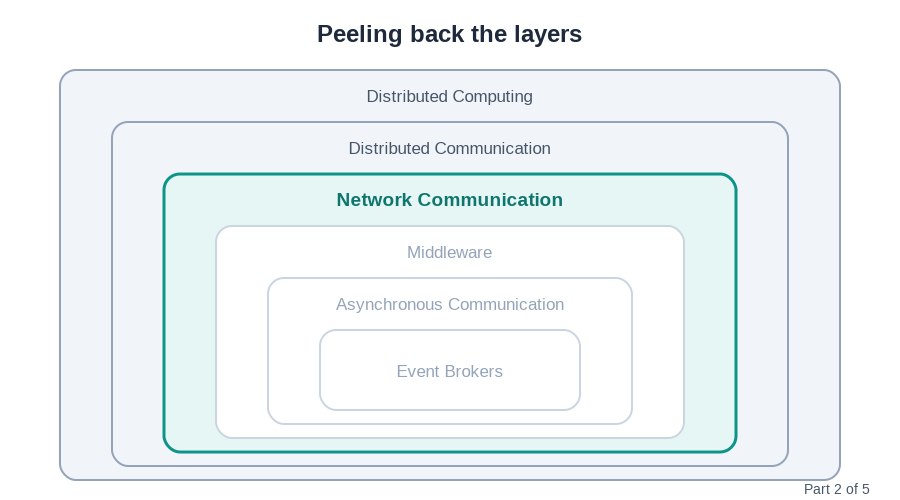
If you’ve read Enterprise Integration Patterns by Gregor Hohpe and Bobby Woolf (it’s on my reading list for a reason), you’ll recognise the order. The book describes four integration styles: file transfer, shared database, remote procedure invocation and messaging. This post covers the first three, plus raw sockets underneath them. Messaging gets its own post.
Talking through a file
The simplest way for two processes to communicate: process 1 writes a file to a shared or networked disk, and process 2 reads it.
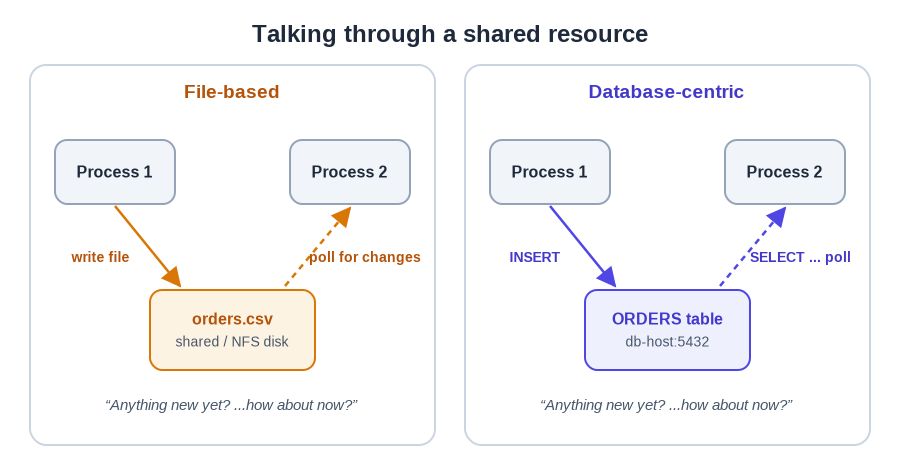
If you’ve been around enterprise IT for any length of time, you’re probably wincing. It’s slow, it’s prone to race conditions (is the file finished, or still being written?), and it’s everywhere. Plenty of organisations still run critical processes on nightly file drops.
Against our objectives:
- Pass data: yes. The file’s contents are the data.
- Trigger: no. Nothing tells process 2 that a file has arrived. It has to sit there polling the directory, which is busy work, not signalling.
- Any scale: no. You’re limited to whoever can see the shared disk. To go further you bolt on FTP, SFTP or a managed file transfer product, which literally copies a directory from one host to another so the trick can work across servers.
Talking through a database
A subtle evolution: swap the file for a database. Process 1 inserts a row, process 2 selects it.
- Pass data: yes, as table records, with types and transactions as a bonus.
- Trigger: still no. Process 2 is still polling, now with
SELECT ... WHERE processed = false. Poll too often and you hammer the database. Poll too rarely and you’re slow. Teams usually settle on a compromise, which is how a lot of “real-time” systems quietly turned into batch jobs. - Any scale: a little better. The database has an IP address and port instead of a file path, so anyone the network allows can reach it. But a database is a protected resource. You don’t open it to the world, and every new consumer adds load and couples itself to your schema.
The real lesson from these two: the only way to communicate at scale across a distributed system is directly over the network. Shared storage is a detour.
Going over the wire: sockets
So let’s talk over the network directly. Two processes, some network between them (Ethernet, Wi-Fi, the internet, it doesn’t matter), and a well-known IP address and port where one of them listens. One side writes bytes to the socket and the other side reads them.
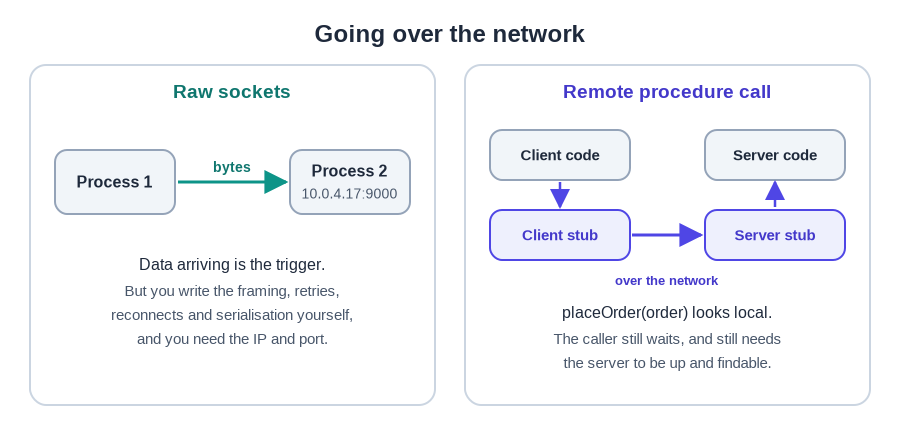
This is the foundation of the client-server model: clients can be anywhere, as long as the server is somewhere known.
- Pass data: yes. Data goes in one end and comes out the other.
- Trigger: yes. Data arriving on the socket is itself the trigger for the receiver to act.
- Any scale: yes. If there’s a reachable IP and port, it can be anywhere. Internet scale is possible.
Three for three. This is the beginning of distributed applications at real scale. But we’re not done, because anyone who has written socket code knows the catch.
Hiding the sockets: remote procedure calls
Raw socket programming is hard. You have to frame messages, serialise data, handle partial reads, reconnect when the connection drops and decide what to do when the other side vanishes mid-conversation. Nobody wants to rewrite that for every interaction.
Remote procedure calls were the answer. You call placeOrder(order) as if it were a local function. Generated stubs on each side turn the call into bytes, send them across the network, run the function on the server and send the result back. Sun RPC, CORBA, Java RMI and DCOM all followed this idea, and gRPC is its modern descendant.
RPC ticks the “no socket code” box. But making a remote call look local hides exactly what the fallacies of distributed computing warn about. The caller still needs to know where the server lives. The server still has to be up right now. And the caller still sits and waits until the server is done.
Let’s get greedy: more objectives
Now that we’re talking over the network, let’s ask for more. First: shield me from socket programming. And then the big one, so important I used to say it three times on the slide in my training courses: decoupling, decoupling, decoupling.
- Decouple me from the location of other processes. Yes, there’s an IP and port, but IPs change, ports change and processes move. I don’t want that baked into my app.
- Decouple me from the availability of other processes. The other side might be down, restarting or cut off by a network blip. That shouldn’t be my problem in the moment.
- Decouple me from the pace of other processes. If I can produce work faster than the downstream can handle, I don’t want to slow down to its speed.
Here’s how everything so far scores against all seven objectives:
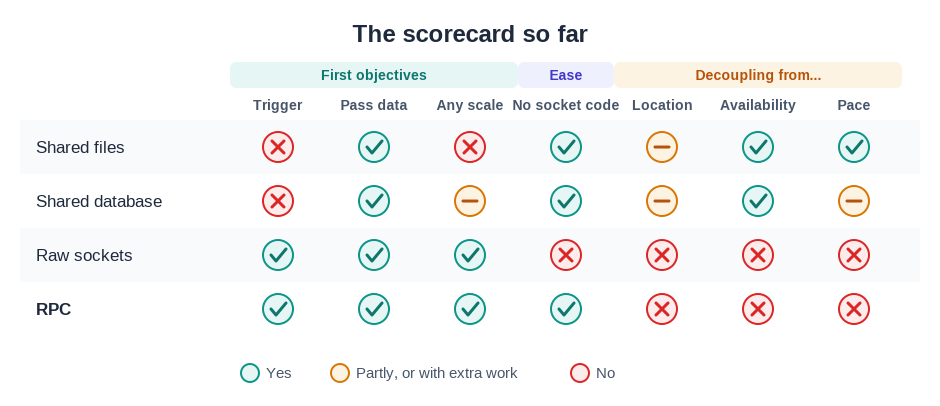
Look at the decoupling columns. Files and databases do surprisingly well. The file sits there whether or not the reader is running, and the reader can take it at its own pace. What they lack is immediacy and reach. Sockets and RPC are the opposite: immediate and far-reaching, but tightly coupled in every way.
What we want is the decoupling of a file drop with the immediacy and reach of a network connection. Put all seven objectives in a basket, give it a good shake, and something specific falls out.
Wrapping up
Files and databases pass data but can’t signal and can’t reach far. Sockets signal and reach anywhere, but leave you writing plumbing. RPC hides the plumbing but keeps every kind of coupling. None of them hits all seven objectives.
Next up: what fell out of the basket. Message-oriented middleware, and how putting a broker in the middle delivers all three kinds of decoupling.