TL;DR
- An event is an immutable record that something changed. A command is an instruction aimed at one consumer that expects an answer back.
- A message is the envelope (header plus body). Put an event in the body and you have an event message, routed by an event broker.
- Topics are one-to-many (publish/subscribe) and usually hierarchical with wildcards. Queues are one-to-one (point-to-point) and hold events until a consumer acknowledges them.
- Loose coupling isn’t no coupling. The event schema is still a contract between producer and consumer.
- Direct delivery is fast and may drop events. Guaranteed delivery stores first, acknowledges at each hop, and can redeliver, so consumers should handle duplicates.
When I taught event-driven architecture, back in my customer training days, the first half hour always went on vocabulary and getting the foundations of EDA right. There is still some confusion among people getting started with EDA about how to tell an event from a message or a command. One person says “event” and means a notification, another means a request in disguise.
So this post is the glossary I wish I could hand out before every session. It’s vendor-neutral and quick to scan. If you want the longer story of why these ideas exist, the Distributed Computing Primer series builds up to them step by step.
Event
An event is a notification that the state of something changed. Usually that something matters to the business: an order was placed, a payment cleared, a temperature crossed a threshold.
Three properties are worth memorising:
- It’s a record of the past. “Order created”, not “create order”.
- It’s immutable. You can’t change what already happened. If the order changes, that’s a new event.
- The producer doesn’t know who’s listening. It announces the fact and moves on. There’s no reply.
A few everyday examples: a home thermostat reporting that the living room is too warm, a stock price ticking up, or a rideshare app telling you your driver has arrived.
Event stream
An event stream is a continuous, unbounded series of events, ordered by the time each one happened.
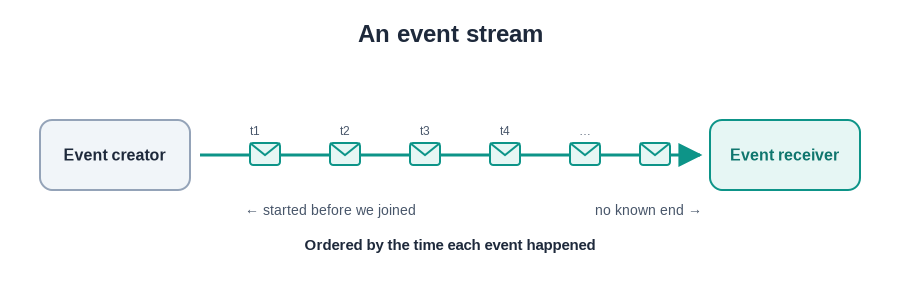
“Unbounded” is the important bit. The stream probably started before your application began reading it, and it has no planned end. You process it as it flows rather than waiting for a complete data set.
In practice you’ll meet two kinds. Some streams you design yourself as part of a solution, such as the orders placed on an e-commerce site. Others you plug into, like GPS updates from a fleet of vehicles or readings from IoT sensors.
Command
A command is an instruction to do something. Unlike an event, it’s usually aimed at a specific consumer, and the issuer expects confirmation that it was carried out.
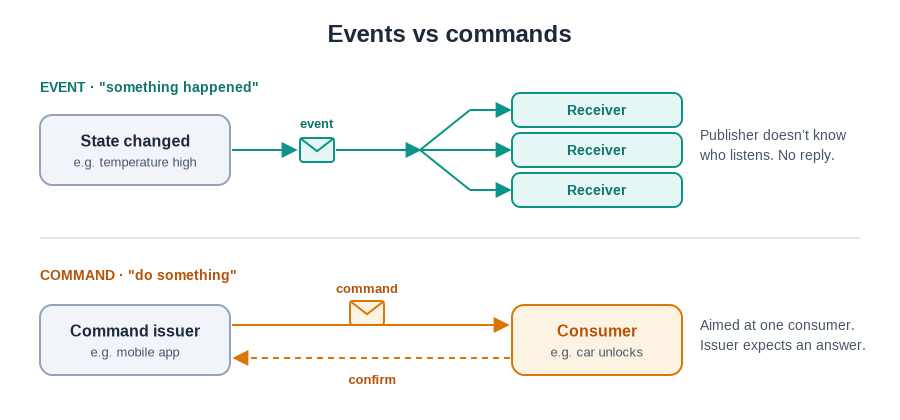
Unlocking your car from a phone app is a command. So is a train-protection system applying the brakes when a driver misses a signal. Often the two work together: the thermostat publishes a “temperature high” event, and a home controller reacts by sending a “turn on the air conditioning” command.
A useful test is the tense. Events are past tense and nobody owes them an answer. Commands are imperative and somebody does. Gregor Hohpe and Bobby Woolf call these the Event Message and Command Message patterns.
Message, event message and event broker
A message is the unit of data moved between applications. It has two parts:
- A header with metadata: destination, ID, timestamp, content type and so on.
- A body, or payload, with the actual data.
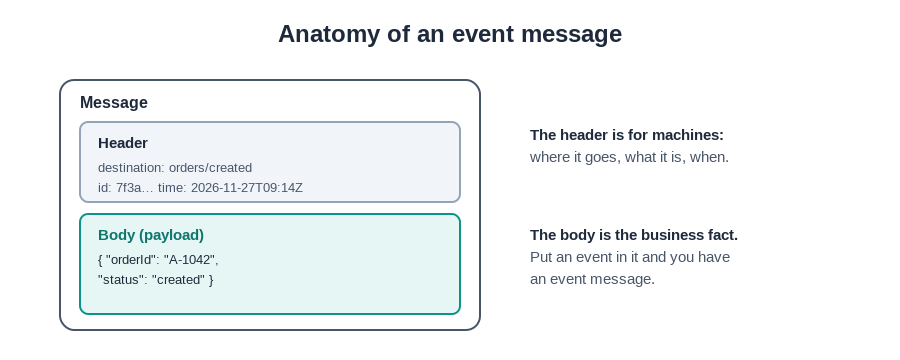
A message can carry an event, a command or any raw data. When it carries an event, people call it an event message. The distinction I like: events are visible to the business, while messages are what the plumbing sees.
The middleware that routes event messages from producers to interested consumers is an event broker. You’ll also hear “message broker” for the same kind of product. The name usually tells you more about the speaker’s background than about the software. I covered how we got here in Event Brokers and the Event Mesh, Explained.
Loose coupling (but not no coupling)
Loose coupling is the headline benefit of event-driven design. Producers publish without knowing who consumes. Consumers subscribe without knowing who produces. Each side can be written in a different language, run on a different platform, and be deployed or scaled on its own schedule.
But loose isn’t zero. A consumer decides what data it needs and in what shape. A producer publishes events it hopes are useful, which creates an implicit contract. If an order event is JSON, both sides need to agree on its schema, and a careless field rename will break someone you’ve never met.
Two habits help. Treat event schemas as versioned, published APIs. And keep the number of distinct event types flowing between modules small, because every new type is another contract to maintain.
Event channels: topics and queues
Producers don’t fling events into the broker at random. They publish to an event channel, a logical address on the broker, and consumers subscribe to the channels they care about. A broker hosts many channels, each carrying a different kind of event.
There are two main types:
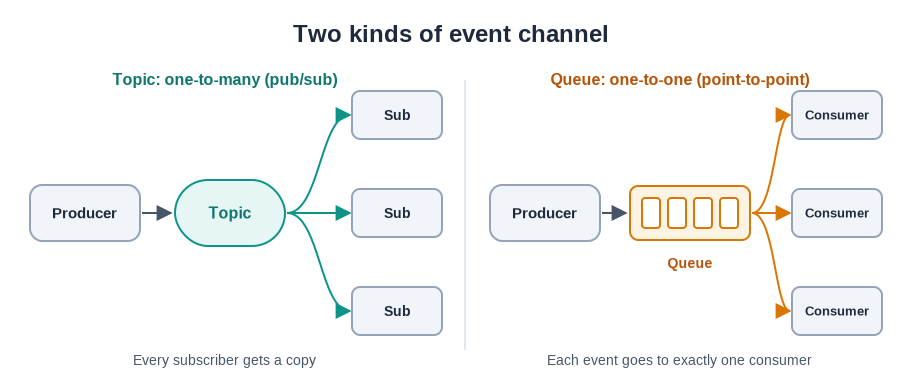
- A topic is one-to-many, the publish/subscribe model. Every subscriber gets its own copy. Use it when several parties care about the same event.
- A queue is one-to-one, the point-to-point model. Several consumers can read from the queue, but each event goes to exactly one of them. That’s how you load-balance work, such as making sure each order is processed once.
Topic hierarchies and wildcards
Most brokers let topics have a hierarchy, much like folders in a file system. A thermostat might publish to myhome/livingroom/temperature and myhome/livingroom/humidity.
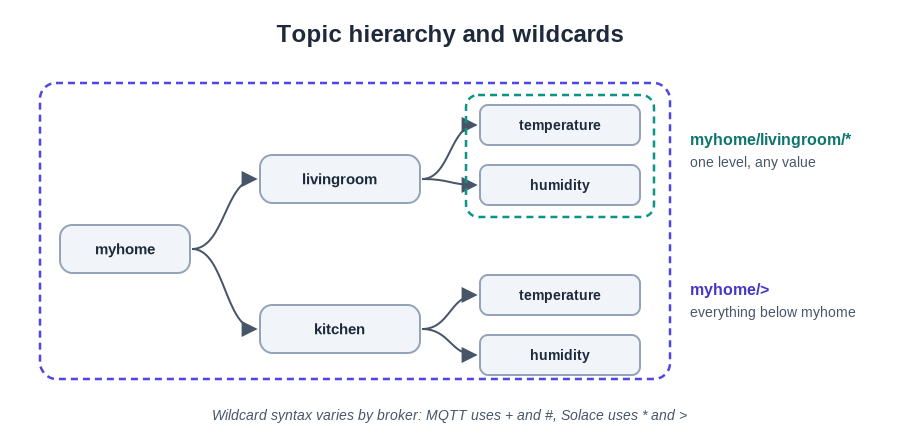
Subscribers can then use wildcards to subscribe to many topics at once. One wildcard matches a single level (myhome/livingroom/* gets temperature and humidity), and another matches everything below a point (myhome/> gets the lot). The characters differ by protocol: MQTT uses + and #, while all other protocols in Solace use * and >. The idea is the same everywhere, and good topic design is a big enough subject to get its own post in the patterns series.
Queues add persistence
Queues have no hierarchy, but they bring something topics on their own don’t: persistence. A queue stores events until a consumer has processed them, so nothing is lost if the consumer or the broker restarts. Acknowledgements make this work:
- The producer gets an acknowledgement once the broker has safely stored the event.
- The consumer sends an acknowledgement after processing, and only then is the event removed.
Clients
Any application that sends or receives events through a broker is a client of that broker. Unfortunately the industry has several pairs of names for the two ends:
| Sending side | Receiving side | Where you’ll hear it |
|---|---|---|
| Sender | Receiver | The most generic pair |
| Producer | Consumer | Very common, especially with queues and streams |
| Publisher | Subscriber | Publish/subscribe over topics |
| Requestor | Provider (or replier) | Request/reply, where an answer comes back |
They’re mostly interchangeable. Pick one pair for your team and stick to it in your docs.
Quality of service: direct vs guaranteed
Quality of service (QoS) decides how hard the broker tries to get an event through. Not every event deserves the same treatment. Losing a new-order event costs money. Losing one “where’s my order?” status ping costs almost nothing, and the user will just ask again.
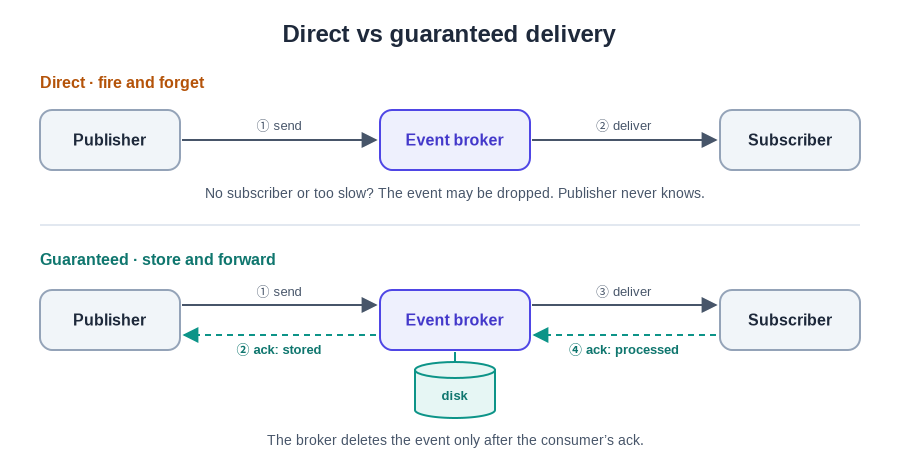
Direct delivery, also called fire and forget or best effort, is the fast path. The broker forwards the event to whoever is subscribed right now. If nobody is subscribed, or a subscriber falls too far behind, the event can be dropped and the publisher never hears about it. In delivery-semantics terms that’s at most once. It’s a good fit for high-rate data where the next update replaces the last one, such as prices, telemetry and heartbeats.
Guaranteed delivery, also called persistent or store and forward, is the safe path. The broker writes the event to disk and acknowledges the publisher. It then delivers to the consumer and keeps the event until the consumer acknowledges it. If the consumer crashes mid-processing, the event is delivered again when it reconnects. If the broker can’t store an event (say the disk is full), it sends the publisher a negative acknowledgement and the publisher decides whether to retry.
Redelivery means guaranteed delivery is usually at least once, so a consumer may occasionally see the same event twice. Make your consumers idempotent and it won’t matter.
Publish to topics, persist in queues
You don’t have to give up publish/subscribe to get guarantees. A common pattern, and the one I recommend, is to have producers always publish to topics and then attach queues that subscribe to those topics.
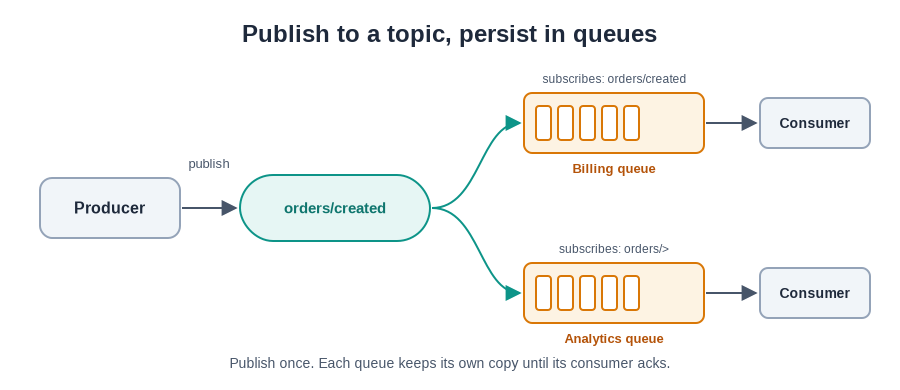
The producer publishes once. Each queue picks up the events matching its subscriptions and holds its own copy until its consumer acknowledges. Adding a new consumer later means adding a queue, not touching the producer. Not every broker supports this topic-to-queue mapping natively, but where it exists it’s one of the most useful tools you have.
Wrapping up
That’s the core vocabulary: events and commands, streams, messages and brokers, topics and queues, clients and quality of service. If you’re just learning EDA, this is the basic vocabulary to know, and it will help you have better design conversations with your teams.